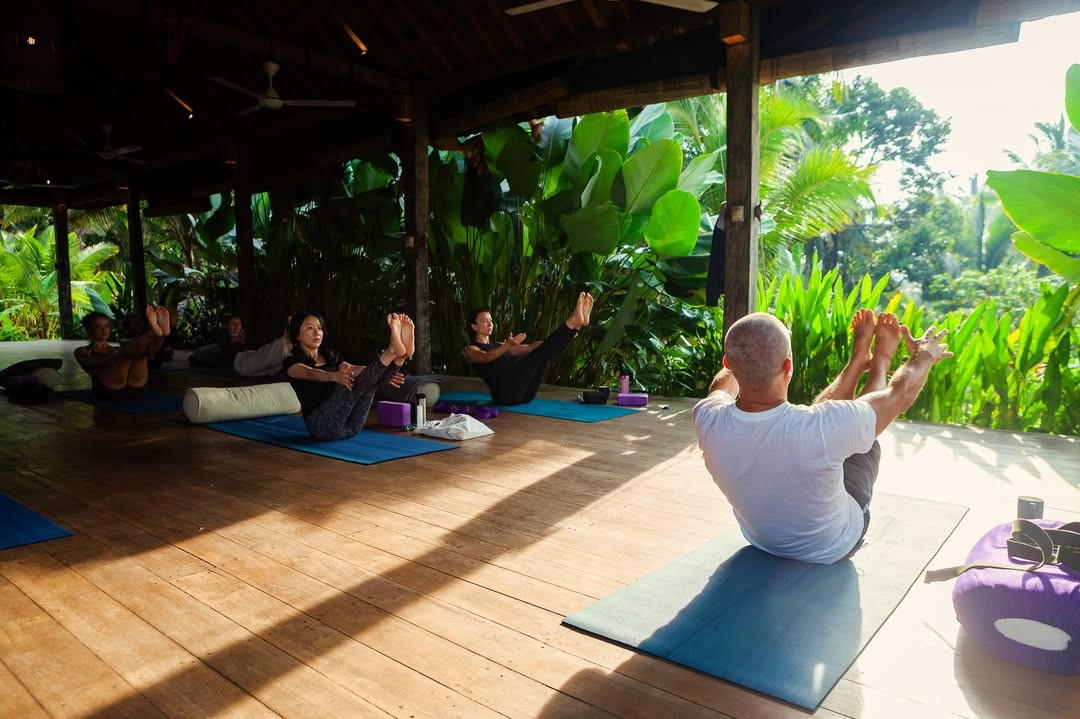
A 200-hour yoga teacher training is the foundational course that certifies you to teach yoga and earns you the globally recognised RYT 200 credential. In short, it is the qualification that turns a dedicated student into a teacher. The real question most people are asking, though, is whether it is worth the time and money, and that deserves an honest answer rather than a sales pitch.
Here is the short version. For people who want to teach, deepen their practice, or step away for a month of focused growth, a 200-hour training is almost always worth it. For people a few weeks into yoga, or unable to commit the time and budget right now, waiting usually pays off. Below we explain exactly what the course is, what you learn, and how to judge the decision for yourself.
The Short Answer: What a 200-Hour YTT Is?
A 200-hour yoga teacher training packs 200 contact hours of study into a structured program, usually across three to four weeks in a residential setting. During that time you deepen your own practice, learn how the body moves, study yoga philosophy, and build the skills to lead a safe, well-sequenced class.
The format matters more than the brochure suggests. Offline, in-person training still accounts for roughly three quarters of the yoga education market, because hands-on posture correction and live feedback are hard to replicate on a screen. That is precisely what a residential course in Bali gives you.
What RYT 200 and Yoga Alliance Actually Mean?
Yoga Alliance is the largest international registry of yoga teachers and schools, founded in 1999. When a school meets its standards it becomes a Registered Yoga School, and its graduates can register as a Registered Yoga Teacher, or RYT 200.
Worth knowing before you pay: Yoga Alliance is a registry, not a certifying body, and registration is voluntary rather than a government licence. The credential signals a verified training standard, which carries real weight with studios, but it is the quality of your school that determines whether you can actually teach. Choose the school first, the logo second.
What You Actually Learn in a 200-Hour Training?
The curriculum balances five core areas: techniques and practice, teaching methodology, anatomy and physiology, philosophy and ethics, and a supervised practicum where you teach and receive feedback. Techniques and practice take the largest share, at a minimum of 100 hours under current Yoga Alliance standards.
Strong schools add depth on top of that baseline. Inner Yoga, for example, layers in Traditional Chinese Medicine, voice activation, and a Business of Yoga module alongside the standard subjects. For the full subject-by-subject map, see what subjects are covered in a 200-hour yoga TTC.
How Long It Takes and What It Costs?
As a residential intensive, a 200-hour course usually runs three to four weeks, while part-time and online formats spread the same hours over months. In Bali, all-inclusive tuition commonly sits between 1,500 and 4,000 US dollars.
Inner Yoga's 200-hour training starts from 2,750 US dollars at the early-bird rate, with accommodation, meals, airport pickup and certification fees included. For real numbers and a sample budget, see the dates and pricing page.
Who a 200-Hour YTT Is Worth It For, and Who Should Wait?
It is clearly worth it if you want to teach, deepen your practice, or take a structured month of growth. Tellingly, about one third of students at schools like Inner Yoga enrol with no plan to teach and still describe the experience as life-changing.
On the other hand, you might wait if you have practised for only a few weeks, or if the time and budget are not realistic yet. Building a steady practice first means you arrive ready to absorb the material rather than spending week one catching up.
Is a 200-Hour Yoga Teacher Training Worth It in 2026?
The market backdrop is genuinely strong. Global yoga industry analyses put the sector at well over 120 billion US dollars in 2025, growing at roughly 9 percent a year, with an estimated 300 million practitioners worldwide. Demand for qualified teachers tends to track that growth, particularly online, which is expanding faster than any other format.
So the credential is a smart, reasonably future-proof investment. Ultimately, though, the value depends on your goals. If you want to teach or transform your practice, a 200-hour training is absolutely worth it, and our complete guide to 200-hour yoga teacher training in Bali walks through every part of the decision. If you mainly want a holiday with yoga attached, spend the money on a retreat instead and come back for the training when you are ready.
Ready to take the next step? Curious whether our 200-hour course is the right fit? Book a free, no-pressure 20-minute call with the Inner Yoga team to talk through your goals and the next available cohort in Ubud.
Frequently Asked Questions
Does a 200-hour training qualify me to teach?
Yes. RYT 200 is the recognised entry-level teaching qualification. Once you register with Yoga Alliance you can teach beginner and general classes professionally, in studios, online, or independently.
Is it worth doing if I never plan to teach?
Often, yes. Many students enrol purely for personal growth and leave with a stronger practice, deeper anatomy and philosophy knowledge, and a noticeable reset in stress and sleep. The benefits extend well beyond a teaching career.
What is the difference between RYT 200 and a certificate of completion?
Your school issues the certificate of completion. RYT 200 is the
optional registration you add by submitting that certificate to Yoga Alliance
and paying an annual fee. You can teach with the certificate alone, but RYT
status is what most employers look for.