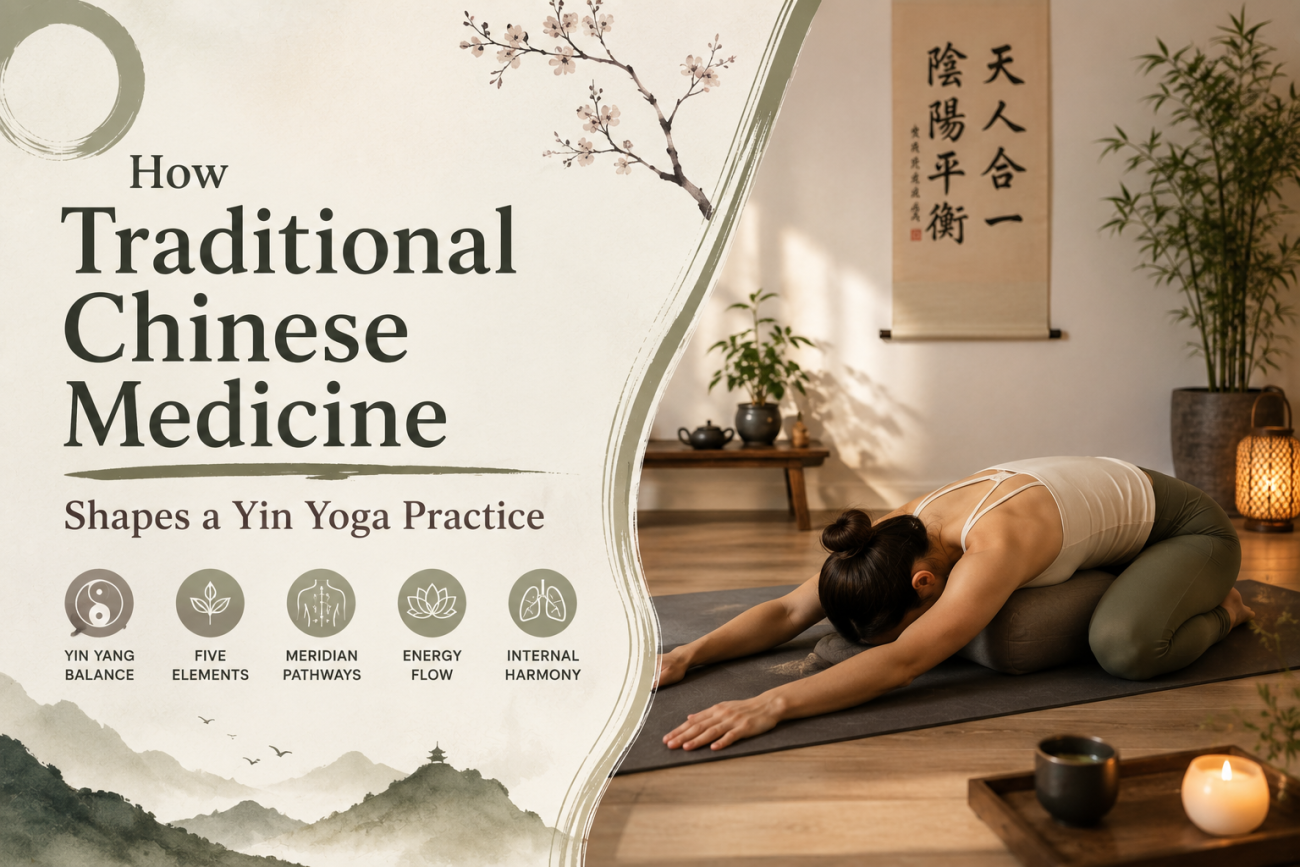
Quick answer. Traditional Chinese medicine gives Yin yoga its energetic map. In this framework, long-held poses stimulate meridians, the channels through which qi, or life energy, is said to flow. Paul Grilley wove meridian theory into Yin from around 1990, which is why a Yin class often targets specific organ lines rather than muscle groups.
To understand why a Yin class feels so different, you have to look east, because traditional Chinese medicine shapes almost everything about the practice. Where active yoga tends to think in muscles, Yin thinks in energy lines. This article explains the meridians, qi and the five elements behind Yin, and does so honestly, separating the traditional framework from what modern science can and cannot yet confirm.
How Does Traditional Chinese Medicine Shape Yin Yoga?
Traditional Chinese medicine, often shortened to TCM, provides the philosophy that gives Yin its purpose. In this view, health depends on the smooth flow of qi, a vital energy, through the body. Yin poses are designed to stimulate that flow, which is why they are held long and still rather than repeated quickly.
This is the layer that turns Yin from simple stretching into an energetic practice. The physical shape is only half the story; the intention behind it is to nourish the body's energy system.
What Are Meridians, and Why Do They Matter in Yin?
Meridians are the channels through which qi is said to travel, according to TCM. Each meridian links to an organ and its associated functions, so the practice maps the body as a network of energy lines rather than muscle groups.
In a Yin class, a pose is often chosen for the meridian it targets, not the muscle it stretches. A deep forward fold, for example, is thought to work the lines associated with the kidneys and bladder. That is why Yin teachers speak of energy and organs where a fitness class would speak of hamstrings.
How Did Meridian Theory Enter Yin Yoga?
The link is surprisingly recent and traceable to one meeting. Around 1990, Yin teacher Paul Grilley met Dr Hiroshi Motoyama, a scholar who studied the meridian system. Motoyama's work helped Grilley connect the long-held postures he taught with the energy channels of TCM.
Grilley then blended anatomy, Taoist yoga and meridian theory into the core of modern Yin. That synthesis is why today's Yin classes carry a distinctly Chinese energetic vocabulary alongside their Western anatomy. Our guide to what Yin yoga is traces that history in full.
The Five Elements and the Organ Lines
TCM also organises the body through the five elements: wood, fire, earth, metal and water. Each element connects to particular organs, emotions and meridian pairs, and many Yin teachers theme classes or sequences around them.
A water-element practice, for instance, might focus on the kidney and bladder lines and the theme of stillness, while a wood-element practice might work the liver and gallbladder lines. This framework gives Yin a depth that reaches beyond the physical into the emotional and seasonal.
Does Science Support the Meridian Model?
Here honesty matters. Meridians are a traditional framework, not a proven anatomical structure, and Western science has not confirmed qi or the channels as physical features. It would be misleading to present the model as settled biology.
What researchers do study is fascia, the connective tissue web that Yin loads, and some teachers suggest fascia may be a physical correlate for parts of the meridian map. That link remains a hypothesis rather than an established fact. You can hold both truths at once: the meridian model is a rich, useful map for practice, even as the science continues to investigate why Yin feels so effective. To explore the practice itself, see our guide on Yin versus restorative yoga, or study the framework in depth on our 100-hour Yin yoga teacher training.
Frequently Asked Questions
What are meridians in Yin yoga?
Meridians are the energy channels described in traditional Chinese medicine, through which qi is said to flow. Yin poses are held long to stimulate these lines, each linked to an organ and its functions.
Is the meridian system scientifically proven?
No. Meridians are a traditional framework rather than a confirmed anatomical structure. Modern research focuses on fascia, which some teachers propose as a possible physical correlate, though that link is not yet established.
Why does Yin yoga use traditional Chinese medicine?
Because Yin grew from Taoist roots, and teacher Paul Grilley integrated meridian theory around 1990. TCM gives the practice its energetic purpose, guiding which poses target which organ lines.
What are the five elements in Yin yoga?
Wood, fire, earth, metal and water. Each element links to specific organs, emotions and meridian pairs, and Yin teachers often theme classes around them to add emotional and seasonal depth.