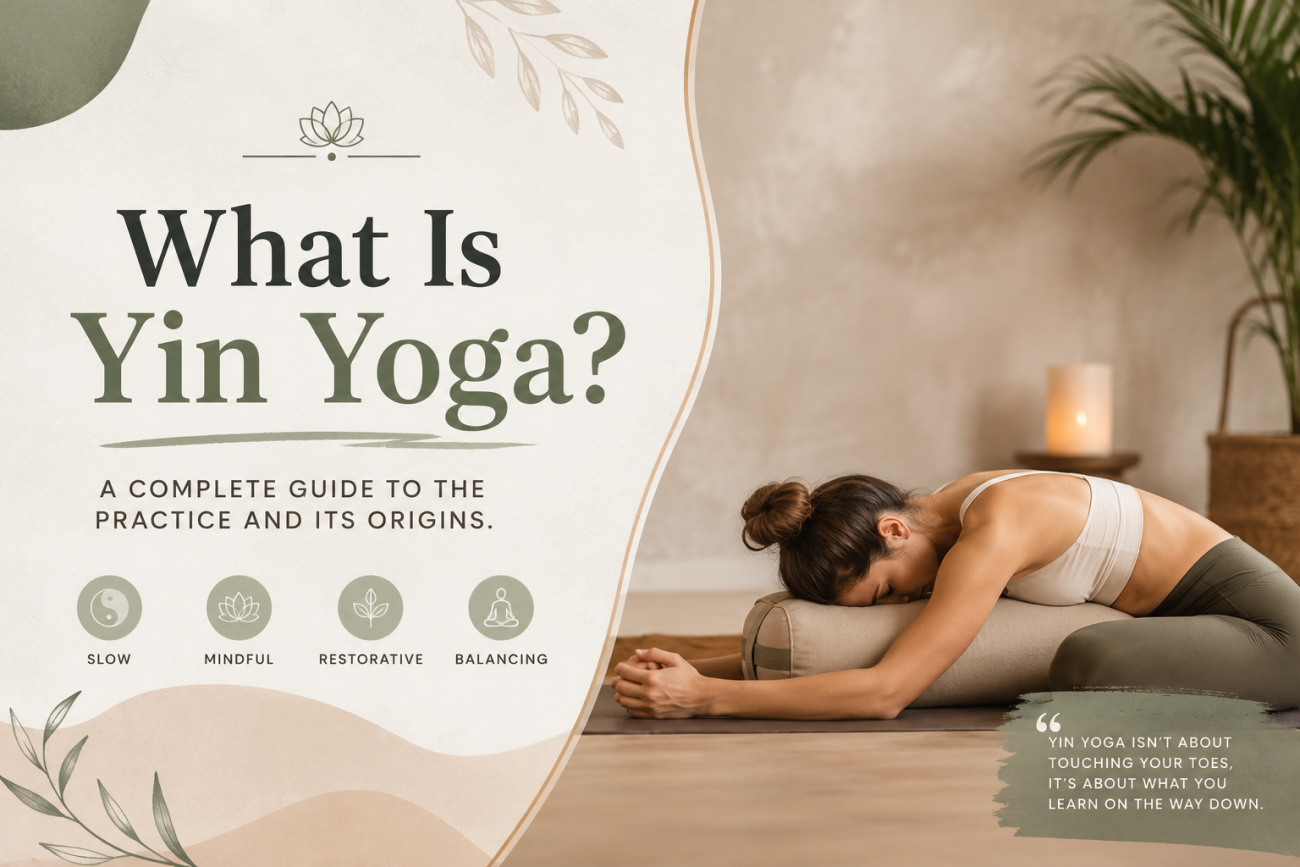
Quick answer. Yin yoga is a slow, meditative style where you hold seated and reclined poses for three to five minutes to gently stress the deep connective tissue, such as fascia, ligaments and joints. Developed from Taoist yoga in the late 1970s, it reaches the parts of the body that faster, muscle-focused styles rarely touch.
If you have only ever practised flowing or strong classes, what is Yin yoga and why does it feel so different? In short, Yin is the quiet, still counterpart to the active styles most studios teach. This guide explains how the practice works, where it came from and who it suits, so you can decide whether this slower path belongs in your week.
What Is Yin Yoga, and How Does It Work?
Yin yoga asks you to settle into a pose and stay, usually for three to five minutes, while your muscles stay soft. That stillness is the method, not a lack of effort. By relaxing the muscles, you let gravity and time apply a gentle, sustained load to the deeper connective tissue underneath.
Teachers describe finding your edge, often around 80 percent of a full stretch. You want a clear sensation, never a sharp pain. Over time, that patient loading is thought to improve mobility, hydrate the fascia and support joint health, while the long holds quietly shift you into a calmer state of mind.
Where Did Yin Yoga Come From?
Yin yoga is younger than most people assume. The practice emerged in the late 1970s, when martial arts champion Paulie Zink blended Hatha yoga with Taoist disciplines into what he called Taoist yoga.
One of his students, Paul Grilley, was drawn to the long, passive holds and began teaching a fully Yin practice. Around 1990 Grilley met Dr Hiroshi Motoyama and wove meridian theory and functional anatomy into the method. His own student, Sarah Powers, then suggested the name Yin yoga, since the poses were primarily yin rather than yang. Teachers such as Bernie Clark later helped carry the practice worldwide. To see how that Eastern framework works, read our guide on how traditional Chinese medicine shapes Yin yoga.
What Makes Yin Yoga Different From Other Styles?
The clearest difference is the target. Active styles work the muscles, while Yin deliberately works the connective tissue that muscles usually protect. Three features set it apart.
Long holds: poses last three to five minutes, sometimes longer, rather than a breath or two.
Soft muscles: you relax the muscle so the load reaches deeper tissue.
Stillness over movement: there is almost no flow, which makes Yin as much a meditation as a stretch.
Because it is so different, Yin pairs beautifully with stronger practice. Its founders always framed it as a complement to active yoga, not a replacement. It is often confused with restorative yoga, though the two are not the same, as our guide to Yin versus restorative yoga explains.
What Are the Benefits of Yin Yoga?
Practised regularly, Yin offers benefits that active training rarely delivers on its own.
Deeper flexibility: sustained loading improves range of motion in the hips, spine and shoulders.
Joint mobility: gentle stress supports the health and resilience of the joints.
Stress relief: long, quiet holds guide the body into the parasympathetic, rest-and-digest state.
Mental resilience: staying with mild intensity in stillness builds real patience and focus.
Is Yin Yoga Suitable for Beginners?
Yes, and it is one of the friendliest styles for newcomers. There is no complex choreography and no pressure to be strong or flexible. You simply find a comfortable version of each shape and rest into it, which makes Yin accessible at almost any age or fitness level.
If the practice speaks to you and you want to teach it, our 100-hour Yin yoga teacher training goes far deeper into the anatomy and philosophy behind every pose.
Frequently Asked Questions
How long do you hold poses in Yin yoga? Most Yin poses are held for three to five minutes, and experienced practitioners sometimes stay for up to ten. The long hold is what allows the deeper connective tissue to respond.
Is Yin yoga a stretching or a meditation practice? It is both. Physically it loads connective tissue to improve mobility, while the stillness and long holds create a strong meditative quality that calms the nervous system.
Can Yin yoga replace my regular yoga practice? It is best used as a complement rather than a replacement. Its founders designed Yin to balance active, muscle-based styles, so pairing the two gives the most complete practice.
Does Yin yoga hurt? It should not. You work to a clear edge of sensation, around 80 percent of a full stretch, but never to sharp pain. If a pose hurts, ease off or use props for support.