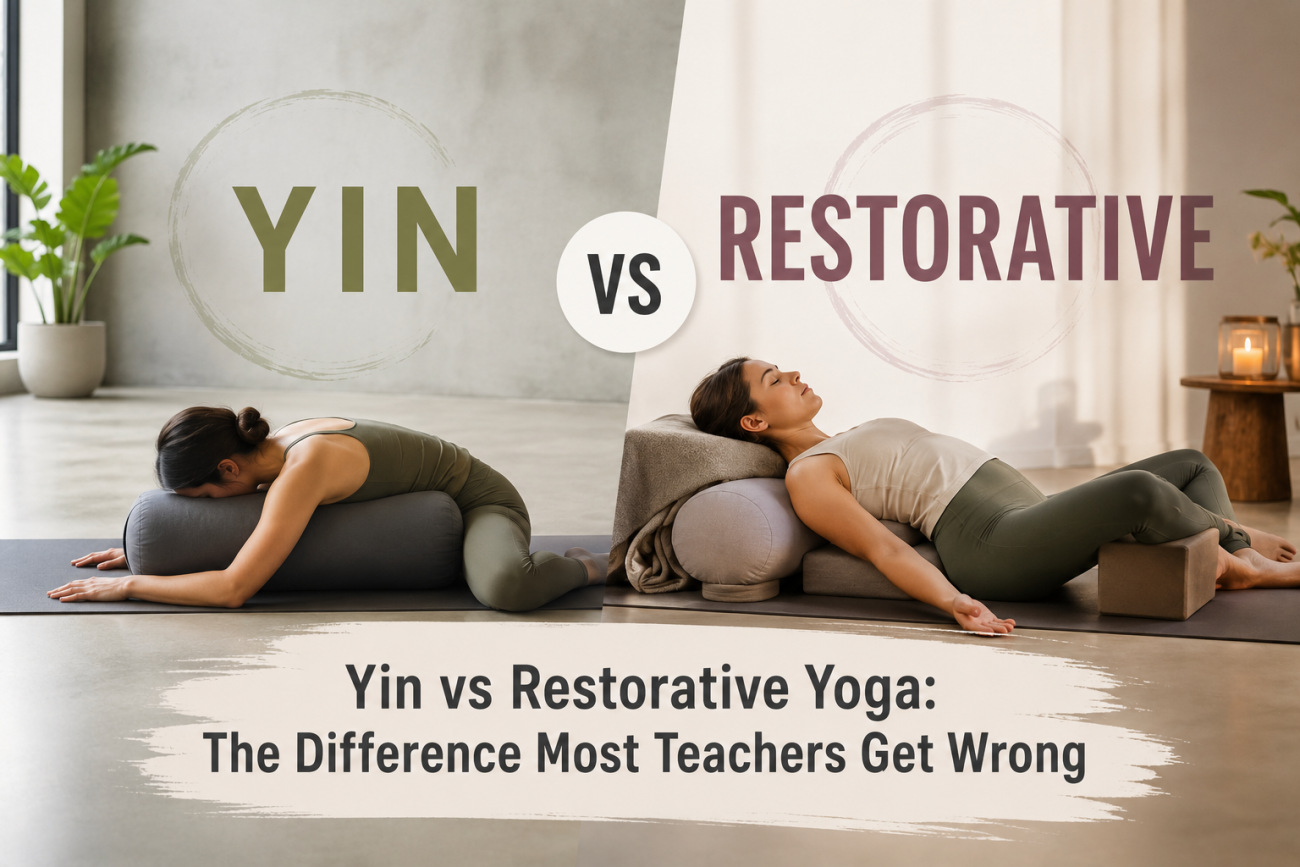
Quick answer. Yin yoga and restorative yoga look almost identical, yet their intent is opposite. Yin applies gentle, sustained stress to connective tissue, holding a clear edge for three to five minutes. Restorative removes all effort with full prop support for five to twenty minutes. In short, Yin works your tissues, restorative rests your system.
Ask ten teachers to explain Yin vs restorative yoga and you will often get ten fuzzy answers, because the two styles look nearly the same from the doorway. Both are slow, quiet and full of props. To cut through the confusion, we compared them against five clear markers: intent, tissue load, props, hold time and effect on the nervous system, drawing on how leading Yin and restorative teachers define each.
Yin vs Restorative Yoga: What Is the Real Difference?
The difference lives in the intent. Yin deliberately introduces stress, so you are meant to feel something. Restorative deliberately removes stress, so you are meant to feel almost nothing. The poses can look identical, yet the purpose is opposite.
Put simply, Yin asks the tissue to adapt, while restorative asks the nervous system to switch off. One is a quiet effort, the other is a complete release.
Why Do So Many Teachers Get It Wrong?
The confusion is understandable, because both styles share the same surface. People lie still on mats, hold poses for minutes and leave feeling calm. Many teachers trained mainly in active yoga, where Yin and restorative each appear only briefly, so the finer distinction slips.
Hold time is the giveaway most people miss. Yin poses last three to five minutes at a working edge. Restorative poses often run five to twenty minutes with no edge at all. Same stillness, very different job.
How Do the Props Work Differently?
Props reveal the true intent of each style, because they do opposite work.
In Yin: props help you find or ease your edge, so the shape meets your body while the tissue still receives a gentle load.
In restorative: props fully cradle the body, raising the floor to meet you so that no effort remains at all.
Restorative also leans on props far more heavily, using bolsters, blankets, blocks and sometimes sandbags and eye pillows. The aim is total comfort. If any strain appears, you add another prop to remove it. Restorative grew out of the Iyengar tradition, which prized precise prop support for healing and recovery.
Which One Should You Practise?
Both styles are valuable, so this is not about a winner. It is about what your body and mind need today.
Choose Yin when you want to improve flexibility, work into tight hips or shoulders and build tolerance for sensation. Choose restorative when you are stressed, unwell, injured or simply depleted, and you need deep nervous-system rest rather than a stretch. Many practitioners keep both in their week. To understand the practice underneath the comparison, start with what Yin yoga is, and if you want to teach these slow styles, see whether you can teach Yin without a 200-hour certificate. You can explore both in depth on our 100-hour Yin yoga teacher training.
Frequently Asked Questions
Is Yin or restorative yoga better for stress?
Both calm the nervous system, but restorative is the more direct choice for pure stress relief, because it removes all effort. Yin also relaxes you while gently working the tissues.
What is the main difference between Yin and restorative yoga?
Intent. Yin applies mild, sustained stress to connective tissue so you feel a clear edge, while restorative fully supports the body with props so you feel almost no sensation at all.
Are Yin and restorative hold times the same?
No. Yin poses are typically held for three to five minutes, while restorative poses often run five to twenty minutes, since the goal is a deep nervous-system reset rather than tissue loading.
Can a class combine Yin and restorative yoga?
Yes. Many teachers blend the two, using Yin to work the tissues and restorative to close with deep rest. Knowing the difference lets you sequence each with the right intent.