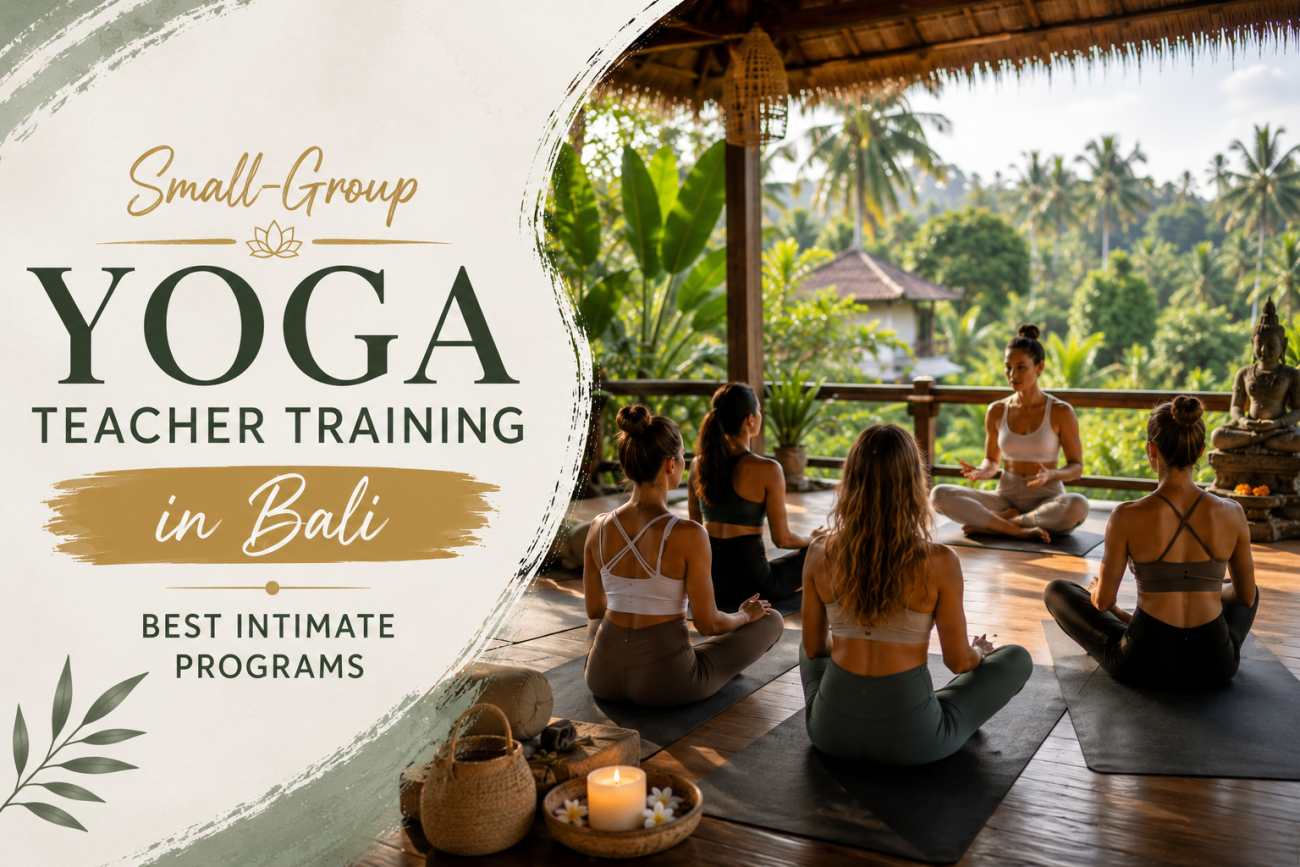
QUICK ANSWER
In a yoga teacher training, cohort size determines how much individual feedback you actually get. A group of 13 to 18 is the practical sweet spot: enough variety of bodies for realistic practicum teaching, small enough for personal feedback. Inner Yoga Training caps every cohort at 18 students, and that cap is enforced rather than aspirational.
Small-group yoga teacher training in Bali draws a specific practitioner. You are not after the biggest program or the most visible brand. You want the experience where the lead trainer knows your name, adjusts your postures precisely, and gives feedback that actually changes how you teach. That requires small numbers, and Bali has a genuine market of intimate, high-quality programs.
Why Group Size Matters
Teacher training is experiential education. You learn to teach by teaching, by receiving adjustments, by having your sequences critiqued, and by watching your trainer work with many bodies. Every one of those processes improves with fewer people in the room.
In a group of 30, practicum time per person is limited, feedback is generalised, and the trainer is managing group dynamics as much as individual development. In a group of 10 to 18, the dynamic changes category: teaching practice is more frequent, feedback is specific, and the trainer's attention is genuinely available to each student.
What Counts as Small
There is no universal definition, but within the Bali market the practical bands are clear.
Cohort size | What it means in practice |
8 to 12 | Genuinely intimate; feedback close to one-to-one, very strong bonds, l |
13 to 18 | The sweet spot for most trainees; realistic practicum and consistent feedback |
19 to 25 | Medium; not small-group in any meaningful sense |
26 and above | Large; practicum time per person drops and attention is thin |
Inner Yoga caps every cohort at 18, at the upper edge of the sweet spot, which keeps practicum realistic while preserving genuine individual attention.
The Benefits of a Small Cohort
More feedback, deeper community, faster confidence
The most cited benefit in graduate feedback is the quality of personalised attention. When a trainer watches you teach a handful of peers rather than twenty, they see your specific patterns: the cue you rush, the adjustment you avoid, the moment your voice loses confidence. That precision is what builds genuine teaching ability rather than surface competence.
Community depth is the second benefit. Three to four weeks in close practice with a small group produces a quality of connection larger cohorts rarely match, and many graduates describe those friendships as among the most significant of their adult lives. Confidence also develops faster, because the barrier of teaching in front of people is far lower when you know everyone in the room. At Inner Yoga, founder Georgina Watson and the teaching team check in personally with students who find the middle week hard, which is only possible at this scale.
The Trade-Offs to Know
Genuinely small programs often carry a modest price premium, because fewer students means less revenue per intake. The premium is usually small relative to the gain in training quality, but verify that it reflects real numbers rather than marketing language. The other trade-off is scheduling: small cohorts fill faster, so if you want a specific date at a genuinely small school, book earlier than feels necessary.
One question that settles it
Ask any school directly: what is your maximum cohort size, and is it enforced or aspirational? Some schools describe themselves as small-group yet admit 25 to 30 when demand is high. A school confident in its cap will answer plainly. Inner Yoga's answer is 18, enforced.
Is a Small-Group Training Right for You?
You learn best with direct, personalised feedback rather than general instruction.
You find large social groups less comfortable, or simply value depth of connection.
You want your practicum teaching to be substantive, not token.
You are willing to book earlier, and perhaps pay a modest premium, for the experience.
Ready to take the next step? Want a cohort small enough that the teachers truly know you?
nner Yoga's 200-hour course is capped at 18, with named specialist teachers per subject. Reserve early, since small cohorts fill fast.
Frequently Asked Questions
What is the ideal group size for a yoga teacher training?
Thirteen to eighteen students is the consensus sweet spot. It is large enough to create genuine variety during practicum, but small enough for faculty to give meaningful individual feedback to everyone throughout the course. Inner Yoga caps cohorts at 18.
Are small-group trainings in Bali more expensive?
Often modestly, because fewer students means less revenue per intake. The premium is usually small relative to the improvement in training quality. Confirm that a small-group claim reflects a real, enforced cap rather than marketing positioning.
Do I get more teaching practice in a small group?
Yes. With fewer students, each person gets more practicum slots and more time in front of the group, and the feedback on each session is more detailed because the faculty's attention is less diluted.