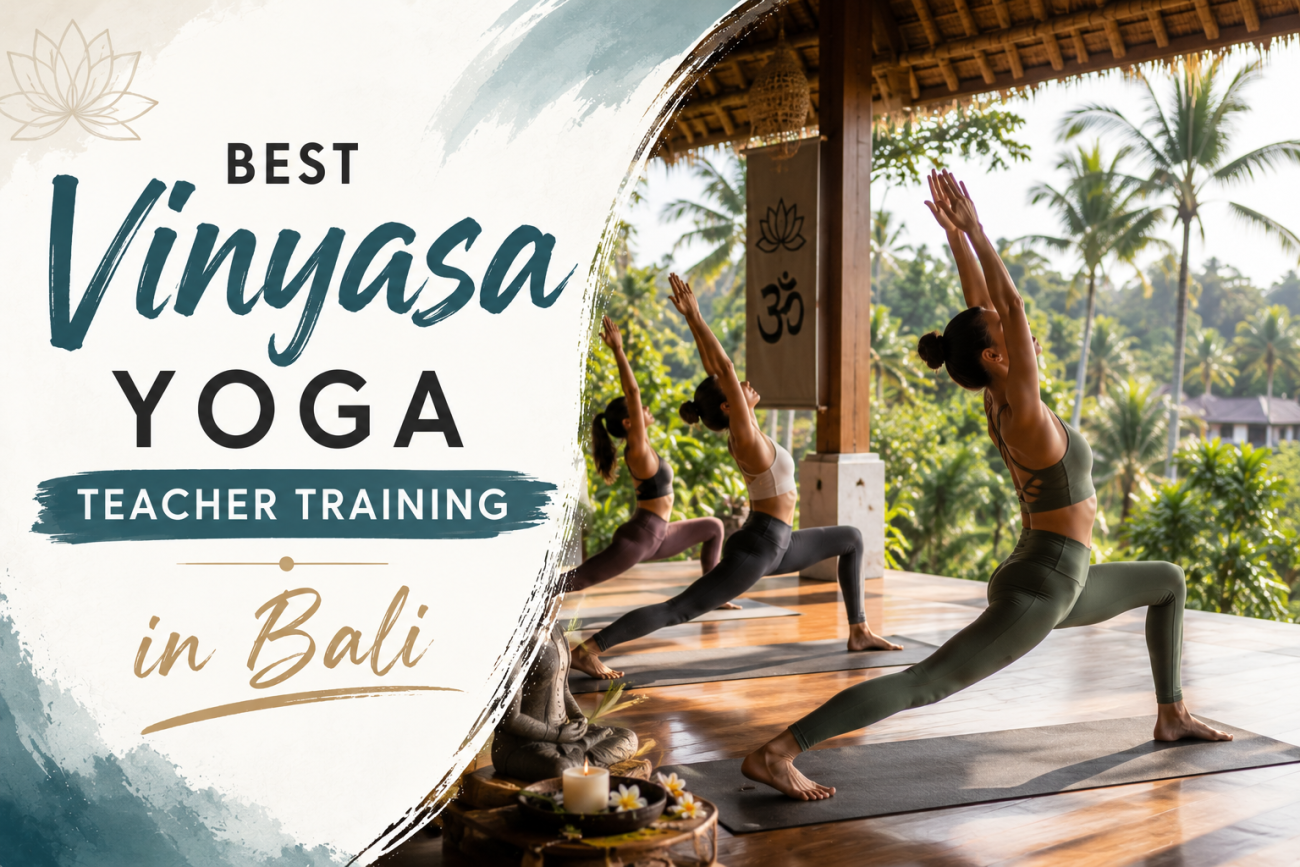
Vinyasa yoga teacher training in Bali draws practitioners who already understand breath-synchronised movement and want to teach it with intelligence and precision. That is a specific, valuable skill set, and not every Bali program builds it equally well. This guide covers what makes a Vinyasa training genuinely strong, what you will learn, and whether it is the right starting point for your practice.
What Makes a Vinyasa Training Different
Vinyasa is a Sanskrit term meaning, loosely, to place in a special way. In modern teaching it refers to a dynamic practice that links movement to breath, where every transition and sequence decision is breath-driven. A strong Vinyasa training does not just teach you to call sun-salutation cues. It develops your grasp of sequencing logic, peak-pose architecture, energetic arc and the biomechanics that keep dynamic movement safe.
The defining elements to look for are detailed work on ujjayi pranayama and its link to movement, progressive sequencing from foundational to advanced shapes, hands-on adjustment technique for flowing sequences, and substantial practicum time with real feedback.
What to Look for in a Bali Vinyasa Program
Apply the same verification as any school: current Yoga Alliance RYS status checked in the registry, a named lead trainer at E-RYT 500, a curriculum that publishes contact hours, and a capped cohort. For a Vinyasa program specifically, ask how much dedicated sequencing methodology and practicum time the course includes, since that is where flow teaching is actually built. The full checklist is in our guide on how to spot an accredited, legitimate yoga school.
Inner Yoga's Vinyasa Training
Inner Yoga's 200-hour course is roughly 60 percent Vinyasa, taught by founder Georgina Watson and a dedicated Vinyasa and anatomy specialist. You learn to build, theme and teach a complete 60-minute Vinyasa class with confidence, with progressive sequencing, breath-movement integration and dynamic adjustments built in from week one. Because the same course also certifies you in Yin, you leave able to teach both a strong flow and a slow, restorative class, which is a more versatile toolkit than most single-style Vinyasa graduates carry. The full subject map is in our 200-hour curriculum guide.
What You Will Learn
Sequencing, flow and breath-movement integration
The core of any quality Vinyasa training is sequencing architecture. You learn to build a class with a clear intention, a logical peak-pose structure and an intelligent cool-down, and to understand why a sequence works physiologically and energetically, not just how it looks.
Breath-movement integration is what separates Vinyasa from general asana instruction. You work extensively with ujjayi pranayama, the victorious breath that underpins the practice, learning how it regulates internal heat, sustains focus and signals transitions. Most strong programs also cover bandha engagement within movement, drishti as an attentional tool, and the energetic qualities of different posture families within a sequence.
Vinyasa vs Hatha vs Multi-Style
Choosing between these is one of the most common pre-enrolment questions. Here is the clear way to think about it.
A pure Vinyasa training suits you if your own practice is already Vinyasa-based and you know most of your future teaching will be dynamic flow. You will go deeper into flow methodology than a broader course can.
A Hatha training suits you if you want to teach slower, alignment-based classes and value classical philosophy, with poses held long enough to study them closely.
A dual or multi-style training suits you if you are newer, want maximum flexibility, or are not yet sure where you will teach. Inner Yoga's dual Vinyasa and Yin course sits here, pairing real Vinyasa depth with a second teachable style.
Who Vinyasa Training Is Best For
Your practice has been predominantly Vinyasa or flow-based for at least 18 months to two years.
You want to teach dynamic, breath-led classes in studios or retreats.
You understand sun salutations, standing sequences and their transitions.
You are drawn to the physical, energetic quality of flow as a teaching modality.
If you are newer, or your practice spans styles, a dual-style foundation like Inner Yoga's keeps more options open. If you have no teaching experience at all, our guide on doing a 200-hour TTC with no experience will reassure you.
Ready to take the next step? Want real Vinyasa depth plus a second teachable style?
Inner Yoga's 200-hour course is roughly 60 percent Vinyasa and certifies you in Yin too. Reserve your place or book a free call.
Frequently Asked Questions
Is Vinyasa good for a first yoga teacher training?
Yes, if your personal practice is already Vinyasa-based. If you are newer to yoga overall, a dual or multi-style program gives a more secure foundation before specialising. The question is whether your current practice gives you enough embodied understanding of flow to learn to teach it well.
What is the difference between Vinyasa and Hatha teacher training?
Vinyasa training focuses on dynamic, breath-linked sequences, flow, transitions and energetic arc. Hatha focuses on alignment-based postures held longer, classical philosophy, and pranayama as a separate practice. Both produce Yoga Alliance RYT 200 graduates; the difference is what you are most prepared to teach immediately after.
Can I teach other styles after a Vinyasa training?
Yes. Your RYT 200 covers yoga teaching broadly, not just Vinyasa, and many flow-trained graduates also teach Hatha or restorative classes. For specialist styles like Yin or Iyengar, additional training in that tradition is advisable. Inner Yoga's course covers both Vinyasa and Yin from the start.